
 English
 Français
 русский
 Español
 Deutsch
 عربى




What Additives and Auxiliary Materials Change in Epoxy Insulation Performance
Content
- 1 Why Small Formulation Choices Decide Long-Term Insulation Life
- 2 Defining Additives and Auxiliary Materials in Electrical Epoxy Systems
- 3 Functional Categories at a Glance
- 4 Toughening, Stress Relief and Crack Control
- 5 Color Pastes, Release Agents and Cleaning Aids
- 6 Interface Adhesives and Conductive Systems in Accessories
- 7 Application Scenarios and Process Flow
- 8 A Practical Selection Checklist
- 9 Common Pitfalls and Preventive Measures
- 10 Verification Tests Worth Requesting
- 11 Evaluating Suppliers on Evidence
- 12 Frequently Asked Questions
- 12.0.1 Q1: What makes an additive suitable for high-voltage insulation?
- 12.0.2 Q2: Can toughening agents be used in every epoxy casting?
- 12.0.3 Q3: How much additive is typically required?
- 12.0.4 Q4: Why do bubbles appear after casting even when the resin is fresh?
- 12.0.5 Q5: Should a custom formulation be tested before full production?
- 13 Closing Perspective
Why Small Formulation Choices Decide Long-Term Insulation Life
When engineers evaluate a cast insulation component, the base resin usually receives the most attention. Its voltage rating, viscosity and heat class appear on the first page of the datasheet. In many field reviews, however, the root cause of early failure lies in the ingredients added around that base. Toughening agents may be incompatible, accelerators may be dosed too generously, moisture may enter through a filler, or a release agent may leave a film on an insert surface. These details rarely look dramatic on a specification sheet, but they determine whether a part survives years of thermal cycling and electrical stress.
The problems tend to follow a recognizable pattern. A casting may look flawless when it leaves the mold, then develop hairline cracks after several hundred thermal cycles. Another part may pass routine tests but show partial discharge activity once humidity rises. A third may have a glass transition temperature lower than the design requires, so it softens under load during a summer peak. Each symptom points back to the selection and handling of additives and auxiliary materials, not only to the chemistry of the main resin.
This article is written for transformer, switchgear and accessory engineers, as well as technical buyers who must compare formulations. The goal is practical: to explain what each category does, where it helps, where it can backfire, and what evidence to request before approving a system for service.
Defining Additives and Auxiliary Materials in Electrical Epoxy Systems
The phrase additives and auxiliary materials covers a broad group of substances, but it helps to separate them into two roles. Additives are dosed into the formulation to change a measurable property of the cured system, such as impact resistance, color, flow behavior, cure speed or flame performance. Auxiliary materials support the production process rather than the final chemistry. They include release agents, cleaning solvents, interface primers and bonding aids that keep the production line repeatable.
Why Electrical Grade Systems Differ From General Purpose Ones
General purpose epoxy additives are often selected for mechanical or cosmetic goals. Electrical insulation adds several constraints. Dielectric strength must remain stable after aging and humidity exposure, partial discharge resistance cannot degrade, and thermal performance must stay predictable over decades. An additive that improves toughness but leaves ionic residue may be unacceptable in a high-voltage component, because those residues can drive leakage currents and corrosion at metal boundaries.
- Dielectric behavior must remain consistent after heat aging and moisture exposure.
- Ionic impurities must stay low, since they can increase leakage and corrosion risk.
- Thermal class and glass transition margins must hold under realistic operating loads.
- Process compatibility matters, because a good additive that causes gassing or poor flow creates casting defects.
Functional Categories at a Glance
The table below summarizes common categories used in electrical epoxy systems. Dosage varies widely between formulations, so the focus here is on role and typical effect rather than exact amounts.
| Category | Primary Role | Typical Effect | Common Application |
|---|---|---|---|
| Toughening agent | Improves crack and impact resistance | Reduces brittle failure when compatible | Cast coils and bushings |
| Color paste | Provides phase marking and identification | Minimal effect when well dispersed | Product coding and inspection |
| Accelerator | Shortens cure time | Faster demolding, but overdosing raises heat buildup | High-throughput production lines |
| Thixotropic agent | Controls flow and sag | Keeps fillers suspended on vertical surfaces | Complex mold geometries |
| Coupling agent | Improves filler to resin bonding | Better moisture resistance and strength | Filled cast systems |
| Flame retardant system | Reduces burning tendency | May change viscosity and electrical behavior | Indoor and enclosed equipment |
| Release agent | Prevents sticking to molds | Clean release when the film is controlled | Reusable tooling |
| Interface adhesive | Bonds dissimilar surfaces | Stronger boundary between metal and resin | Inserts and accessory joints |
Each category interacts with the others. A toughening agent that works well alone may alter flow enough to trap air when combined with a thixotropic system, so trial batches should always test the complete recipe.
Toughening, Stress Relief and Crack Control
Cracking is one of the most common complaints in cast epoxy insulation. Thermal expansion differences between the resin, embedded metal and fillers create stress at every heating and cooling cycle. Toughening agents help by allowing the matrix to absorb part of that strain before a crack initiates and propagates.
The Trade-Off Between Toughness and Heat Resistance
Many flexible modifiers lower the glass transition temperature of the cured network. In comparable trials, a small addition of a compatible modifier often raised impact resistance noticeably while keeping the glass transition within a narrow band. Overdosing, however, can pull that temperature down by ten or more degrees Celsius, which may erase the thermal margin a designer relied upon.
Moving Away From Polyurethane Systems
Some producers have moved from polyurethane casting compounds to epoxy systems to avoid gas evolution. During polyurethane curing, moisture can react with the isocyanate component and release gas, leaving bubbles and voids that reduce dielectric margin. A well designed epoxy formulation with suitable toughening and moisture control can remove that failure path, although drying of fillers and molds remains essential.
Color Pastes, Release Agents and Cleaning Aids
These materials appear minor on a bill of materials, yet they strongly influence production repeatability and the final appearance of a component.
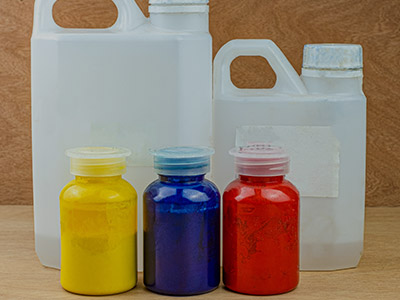
Color Pastes
Pigment dispersions must be fully compatible with the resin and curing agent. Poor dispersion can create specks, weak spots or conductive contamination. Color stability also matters, since some pigments shift in shade after long thermal aging.
- Confirm dispersion stability after the paste has been stored for the expected shelf life.
- Verify that the color holds after the target thermal aging period.
- Check that the paste does not change viscosity enough to alter pouring time.
Release Agents and Cleaners
Release films reduce sticking but can migrate into the surface and weaken adhesion to inserts or later coatings. Low residue formulations are increasingly preferred, both for process reliability and for environmental handling. Cleaning agents should evaporate fully and leave no hygroscopic film. Reusable molds usually need a cleaning cycle after a defined number of casts, and that schedule should be recorded in the production log.
Interface Adhesives and Conductive Systems in Accessories
Cable accessories, gas insulated switchgear spacers and bushings combine metal parts, semiconducting layers and insulating epoxy. Each boundary can become a weak point. Interface adhesives improve bonding between metal inserts and cast resin, reducing the micro gaps where partial discharge often begins.
Bonding Metal Inserts
- Clean metal surfaces using a documented procedure and inspect them under good light.
- Apply primer or adhesive at the specified thickness and allow the defined drying time.
- Keep humidity and temperature within the approved bonding window before casting.
- Verify the result with cross-section samples or suitable non-destructive methods.
Conductive and Semiconducting Layers
Conductive adhesives maintain electrical continuity at grounding points and at interfaces that must carry induced charges safely. Stability across the full temperature range is the key requirement. A system should be chosen only after it has been tested through the thermal cycles that the accessory will actually experience in service.
Application Scenarios and Process Flow
The right combination of additives and auxiliary materials depends heavily on the component and its operating environment. Dry-type cast transformers face thermal cycling and dust, while outdoor accessories face moisture, ultraviolet exposure and pollution. Teams comparing options often begin with a review of epoxy resin additives matched to their voltage class and environmental exposure.
Dry-Type Cast Transformers
Coil encapsulation demands good toughness, controlled flow around windings and stable dielectric behavior after humidity exposure. Defects here are costly because they are often discovered only after energization.
GIS and GIL Insulation Components
Spacers and insulating supports must maintain surface quality and bonding to metal inserts over long service lives. Surface smoothness and void-free casting are critical for limiting discharge activity.
Cable Accessories and Bushings
Accessories experience repeated thermal movement and must keep interface bonds intact. Formulations are often chosen for low residue, stable adhesion and predictable curing under field conditions.
Switchgear and Reactor Parts
Here the focus shifts toward flame behavior, tracking resistance and dimensional stability. Each additive added for one function should be checked against its effect on the others.
A Practical Selection Checklist
Before approving any system, engineers can work through the following questions in order. Answering them early usually prevents expensive rework later.
- Define the minimum glass transition temperature, including a margin for load peaks and ambient extremes.
- Specify viscosity at pouring temperature, along with the pot life needed by the production line.
- Determine whether crack resistance or dimensional stability is the dominant requirement.
- Confirm dielectric and partial discharge results after humidity and thermal aging.
- Check environmental and handling requirements for release agents, cleaners and solvents.
- Decide whether room temperature curing or heated curing better suits the facility.
Common Pitfalls and Preventive Measures
Most field problems repeat across projects. The table below links typical symptoms with their likely causes and the measures that prevent them.
| Observed Problem | Likely Cause | Preventive Measure |
|---|---|---|
| Surface cracks | Excess flexibilizer or thermal mismatch | Limit dosage and test through thermal cycles |
| Bubbles or voids | Moisture in fillers or wet tooling | Dry materials and control shop humidity |
| Soft spots under load | Thin glass transition margin | Confirm dynamic mechanical data |
| Weak insert adhesion | Release residue on metal surfaces | Use low residue release and verify cleaning |
| Color streaks | Incomplete pigment dispersion | Mix to a validated time and temperature |
A recurring lesson is that most defects are cheaper to prevent than to repair. A short qualification run with the full recipe is far more informative than any single property value on a datasheet.
Verification Tests Worth Requesting
A credible supplier or internal development team should be able to supply evidence across four areas. Requesting these results early keeps the qualification focused.
Glass transition data and heat aging results for the complete formulation.
Dielectric strength and partial discharge results after humidity exposure.
Impact and bending results measured at the same dosage as production.
Pot life, gel time and viscosity at the actual pouring temperature.
Evaluating Suppliers on Evidence
Choosing a source for additives and auxiliary materials is less about price per kilogram and more about the depth of the evidence behind each product. The following criteria help separate well documented offerings from general claims.
- Batch consistency records that show repeatable particle size, viscosity and color.
- Full test reports for the specific formulation, not only for a generic base resin.
- Clear storage, shelf life and handling instructions that the production team can follow.
- Engineering support for trials, including the ability to adjust dosage and cure schedules.
Frequently Asked Questions
Q1: What makes an additive suitable for high-voltage insulation?
Suitability depends on stable dielectric behavior after aging, low ionic content, good partial discharge resistance and compatibility with the base system. An additive that performs well mechanically but compromises any of these points is usually a poor fit.
Q2: Can toughening agents be used in every epoxy casting?
Not without checking. Toughening agents can lower the glass transition temperature and change flow behavior, so their use should be confirmed against the thermal and process requirements of each component.
Q3: How much additive is typically required?
The amount depends on the formulation, the target property and the process. Small changes in dosage can shift results noticeably, so the appropriate level should be found through controlled trial batches.
Q4: Why do bubbles appear after casting even when the resin is fresh?
Common causes include moisture in fillers, humid shop air, incomplete degassing and reactions that release gas. Drying materials, controlling humidity and applying proper vacuum steps usually resolve the problem.
Q5: Should a custom formulation be tested before full production?
Yes. A qualification run that covers thermal, electrical, mechanical and process results gives a far more reliable basis for approval than a single datasheet value.
Closing Perspective
Long service life in epoxy insulation rests on the full system rather than the base resin alone. Additives and auxiliary materials determine crack resistance, bonding quality, appearance and electrical stability, and each choice carries trade-offs that must be evaluated together. Engineers who document their requirements, demand complete test evidence and qualify the whole recipe are far less likely to face costly field failures. For teams building a shortlist, a structured formulation review can help align each property with the actual operating conditions of the component.

Contact
Tel: +86-21-54943138
Phone:
Sales Ricky:+86-136 1183 0385
Sales Jason:+86-186 1635 6961E-mail: [email protected]
[email protected]
[email protected]
Get Connected
Copyright © Shanghai Xrun Resin Co., Ltd. All rights reserved. Privacy Custom Epoxy Resin Systems Suppliers
