
 English
 Français
 русский
 Español
 Deutsch
 عربى



How Electrical Epoxy Resin Works: Composition, Performance Data and Selection
Content
- 1 What an Electrical Epoxy Resin Is Made Of
- 2 Performance Data That Matters
- 3 Where Electrical Epoxy Resin Is Used
- 4 How to Choose the Right Grade
- 5 Certifications and Quality Standards
- 6 Frequently Asked Questions
- 6.0.1 Q1: What is the typical dielectric strength of electrical epoxy resin?
- 6.0.2 Q2: Is electrical epoxy resin halogen-free?
- 6.0.3 Q3: What is the difference between potting and encapsulation?
- 6.0.4 Q4: Can electrical epoxy resin be used in high-voltage applications?
- 6.0.5 Q5: What is the typical lead time for a custom formulation?
- 7 Sharing Your Specification for a Review
Anyone who has specified insulation for a transformer, a power module, or a circuit board has faced the same question: which electrical epoxy resin will keep its insulating performance under the voltage, heat, and humidity of the real operating environment? The answer is rarely a single number on a data sheet. It is a balance between dielectric strength, thermal behavior, processing window, and the certifications your customer or regulator requires.
This guide explains how an electrical epoxy resin is built, which values deserve attention on a technical data sheet, where the material is applied, and how to narrow down the choice before requesting a formulation. Instead of general praise for epoxy chemistry, the focus stays on the decisions that engineers and purchasing teams make every week.
Key takeaway: no single property decides suitability. Read dielectric strength, thermal class, cure profile, and certification scope together, and always confirm that the test conditions match your application.
What an Electrical Epoxy Resin Is Made Of
An electrical epoxy resin is a thermosetting system. Once the resin and hardener are mixed and cured, the polymer network forms permanent crosslinks, which means the cured material cannot be melted back into a liquid the way a thermoplastic can. That permanence is useful for insulation because the cured part keeps its shape and electrical behavior under long-term load. It also means the chemistry of every ingredient matters from the first mix.
Most formulations combine four groups of ingredients: the base resin, the curing agent, fillers, and additives. Each group changes a different part of the final performance.
Base Resin Chemistry
Bisphenol A and bisphenol F epoxy resins dominate electrical applications because they offer good adhesion, low shrinkage, and a stable crosslinked structure. For insulation work, the grade of the base resin matters as much as its type. Low-chloride grades are preferred because residual ionic chlorine can migrate under humidity and voltage, raising leakage current and shortening insulation life. Many suppliers specify hydrolyzable chloride content below 0.1 percent for electronics-grade materials.
Fillers and Additives
Fillers are the main lever for balancing thermal and electrical properties. Fused silica reduces the coefficient of thermal expansion and keeps dielectric properties stable across a wide temperature range. Alumina and other ceramic fillers raise thermal conductivity, but they also increase viscosity and can make it harder for the material to flow into fine coil windings.
Flame retardant systems are also changing. Halogen-free alternatives are increasingly requested by customers in consumer electronics and automotive supply chains, and they often require adjustments to cure behavior and filler loading.
Curing Systems
The curing system determines the production line you need. Room temperature systems suit large castings and field repairs, while heat-cured systems suit automated lines and usually deliver a higher glass transition temperature. The table below summarizes the three most common approaches.
| System Type | Typical Cure Profile | Common Use |
|---|---|---|
| Room temperature two-part | 18 to 24 hours at 20 to 25 C | Large castings and field repairs |
| Heat-cured two-part | 1 to 2 hours at 100 to 150 C | Production lines with curing ovens |
| Heat-cured one-part | Single component, stored cold before use | Automated dispensing systems |
Choosing a curing system is not only a chemistry decision. It affects cycle time, energy use, pot life, and how much tolerance your process has for temperature variation on the shop floor.
Performance Data That Matters
Data sheets for electrical epoxy resins can list dozens of values, but only a handful drive most selection decisions. Before comparing two products, check the test method, specimen thickness, and cure schedule behind each number. A dielectric strength value measured on a thin casting is not directly comparable with a value measured on a thick potted sample.
Electrical Insulation
Dielectric strength describes how much voltage gradient the material can withstand before breakdown. Volume resistivity describes how well it blocks leakage through its bulk, while the dielectric constant and dissipation factor describe how it behaves under alternating fields. Typical values for a well-formulated electrical grade are shown below.
| Property | Typical Range | Reference Test |
|---|---|---|
| Dielectric strength | 15 to 25 kV/mm | IEC 60243 |
| Volume resistivity | Above 100 trillion ohm-cm | IEC 60093 |
| Dielectric constant at 1 MHz | 3.5 to 4.5 | IEC 60250 |
| Dissipation factor at 1 MHz | Below 0.01 | IEC 60250 |
The values in this table are indicative industry ranges rather than guaranteed performance. Filled and unfilled systems can differ substantially, so always request the test report for the exact grade you plan to use.
Thermal Management and Heat Resistance
Thermal performance involves three separate questions: how well heat moves through the material, how hot the material can run continuously, and how it expands as temperature changes. Unfilled electrical epoxy resins typically conduct heat at around 0.2 W/mK, which is adequate for low-power parts but limiting for power electronics. Thermally filled grades commonly reach 0.8 to 2.0 W/mK, although higher loading brings a viscosity penalty that can limit flow and air release.
Thermal class is assessed under UL 1446, which assigns insulation systems to temperature classes such as 130, 155, 180, and 200 C. The class reflects the maximum continuous operating temperature of the complete insulation system, not the resin alone. A heat-cured system with a higher glass transition temperature usually supports a higher class, but the system must be tested as a whole.
- Higher filler loading improves thermal conductivity but reduces flow and increases dispensing pressure.
- A closer match between resin and component expansion reduces stress at solder joints and wire insulation.
- Cure schedule changes can shift the glass transition temperature by a meaningful margin, which affects the achievable thermal class.
Mechanical and Environmental Durability
Potted and encapsulated parts face cyclic stress. Differences in expansion between the resin, copper windings, and ferrite or silicon components can create cracks after repeated temperature swings. Toughened formulations and well-chosen fillers reduce this risk. Moisture uptake is another concern. Good electrical grades typically absorb below 0.2 percent water under standard immersion tests, which helps preserve insulation resistance in humid environments.
Chemical resistance matters in automotive and industrial settings where oils, coolants, and cleaning agents contact the surface. Ask for documented resistance data against the specific fluids your product will see, rather than relying on a general claim of chemical resistance.
Where Electrical Epoxy Resin Is Used
Application requirements shape the grade you choose more than any single specification. The four application groups below cover most industrial demand, and each has a different priority.
Transformer and Power Supply Potting
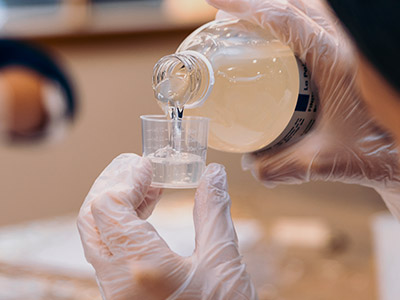
Potting fills a transformer or power module housing so the coil, core, and terminals are fully surrounded by insulation. The main priorities are a low-stress cure to protect fine wire, enough thermal conductivity to move heat out of the windings, and a viscosity that allows complete void-free filling. Vacuum degassing before pouring is standard practice, because trapped air can become a partial discharge site under high voltage.
PCB and Component Encapsulation
Circuit board encapsulation protects components from moisture, dust, and vibration. Ionic purity is critical here. Residual ions from the resin or hardener can cause electrochemical migration between closely spaced conductors, particularly under humidity and bias voltage. Low-chloride grades, controlled filler chemistry, and a clean dispensing process are the usual safeguards. Also consider whether the encapsulant must be reworkable, because some designs require removal of a failed component.
High-Voltage Insulators and Bushings
High-voltage components face tracking and erosion, where surface discharge gradually carbonizes the material. Resistance to tracking and erosion often matters more than bulk dielectric strength alone. Filled systems with stable surface behavior and proven long-term performance are typically preferred, and designs are usually verified with accelerated aging tests before release.
EV and Power Electronics
Electric vehicle battery modules and power semiconductor packages combine high current, heat cycling, vibration, and strict quality requirements. Materials used in these applications are generally qualified against automotive quality systems and subjected to thermal cycling across a wide temperature span. Selection focuses on reliability over many cycles, consistent thermal performance from batch to batch, and traceable manufacturing records.
Across all four groups, the same requirement tags appear repeatedly in specifications:
PottingEncapsulationThermal managementTracking resistanceHalogen-free
How to Choose the Right Grade
A practical selection process moves from the hard limits of the application to the softer details of the process. Working through the questions in this order prevents a common problem: a material that meets every electrical requirement but fails on thermal class or production window.
- Confirm the required thermal class first. Establish the maximum continuous temperature at the insulation, not just the ambient temperature, because self-heating can add a significant margin.
- Determine whether heat must leave the assembly through the encapsulant. If it must, shortlist thermally filled grades and verify that the viscosity still allows complete filling.
- Check the process conditions. The pouring or dispensing method, oven availability, and cure time all constrain which curing system is practical.
- Confirm the certification threshold. Flame rating, RoHS or REACH compliance, and halogen-free requirements can eliminate candidates early, so check them before comparing performance.
If your project involves bonding and insulating the same parts, an epoxy insulating adhesive may be a better starting point than a pure potting compound. Adhesion strength, gap filling, and thermal expansion then become part of the same selection review.
Common Specification Mistakes
- Comparing dielectric strength values measured at different specimen thicknesses.
- Choosing a high thermal conductivity grade without confirming that its viscosity suits the part geometry.
- Specifying a thermal class for the resin alone instead of the complete insulation system.
- Ignoring post-cure requirements, which can leave the glass transition temperature lower than expected.
Certifications and Quality Standards
Certifications are most useful when you understand what each one covers. Many buyers ask for a logo or a certificate number without checking whether it applies to the resin, the finished insulation system, or the manufacturing site. The table below lists the standards most often requested for electrical epoxy resin projects.
| Standard | Scope | Why It Matters |
|---|---|---|
| UL 94 V-0 | Flammability rating for plastic materials | Often required by enclosure and equipment standards |
| IEC 60243 | Electric strength test method | Allows fair comparison of dielectric strength values |
| IEC 60093 | Volume and surface resistivity test method | Indicates leakage current behavior |
| UL 1446 | Thermal class of insulation systems | Defines maximum continuous operating temperature |
| RoHS and REACH | Restricted substances and chemical registration | Required for market access in the European Union |
| IATF 16949 | Quality management for automotive supply chains | Expected from suppliers of automotive electronics |
Certification usually applies to a specific formulation, cure schedule, and specimen thickness. A change in filler, hardener, or curing temperature can invalidate the result, so confirm that your production recipe matches the tested configuration.
Frequently Asked Questions
Q1: What is the typical dielectric strength of electrical epoxy resin?
Well-formulated electrical grades typically fall between 15 and 25 kV/mm when measured under IEC 60243. Results depend on thickness, filler content, and cure conditions, so compare values only when the test method is the same.
Q2: Is electrical epoxy resin halogen-free?
Not all grades are. Conventional flame-retardant systems often contain halogens, while halogen-free options use alternative retardant chemistry. Halogen-free grades are increasingly requested, but they may need changes to the cure schedule and filler loading.
Q3: What is the difference between potting and encapsulation?
Potting fills an entire enclosure around a component, and the housing usually remains part of the finished product. Encapsulation coats or surrounds the component itself, often with a thinner layer. Both processes use similar resin chemistry, but viscosity, cure profile, and fill method differ.
Q4: Can electrical epoxy resin be used in high-voltage applications?
Yes, provided the grade has been qualified for the voltage class, tracking resistance, and thermal conditions involved. Designers usually verify performance with accelerated aging, partial discharge testing, and thermal cycling before release to production.
Q5: What is the typical lead time for a custom formulation?
Lead times depend on how much development work is needed. Standard grades can often ship quickly, while custom formulations typically require sample development, qualification testing, and pilot production before full volume. Planning for several weeks of development is a realistic expectation for new requirements.
Sharing Your Specification for a Review
If you are comparing options for a potting compound for an upcoming project, a short specification review can save several rounds of sample testing. The more precise the input, the faster the recommendation. Useful details include:
- Application type, such as transformer potting, PCB encapsulation, or high-voltage insulation.
- Required thermal class and maximum continuous operating temperature.
- Certification requirements, including flame rating and substance restrictions.
- Expected annual volume and preferred production method.
- Required delivery timing and any qualification milestones.
Send your specification table and we will reply with a formulation recommendation and indicative pricing within 24 hours.
Contact
Tel: +86-21-54943138
Phone:
Sales Ricky:+86-136 1183 0385
Sales Jason:+86-186 1635 6961E-mail: [email protected]
[email protected]
[email protected]
Get Connected
Copyright © Shanghai Xrun Resin Co., Ltd. All rights reserved. Privacy Custom Epoxy Resin Systems Suppliers
